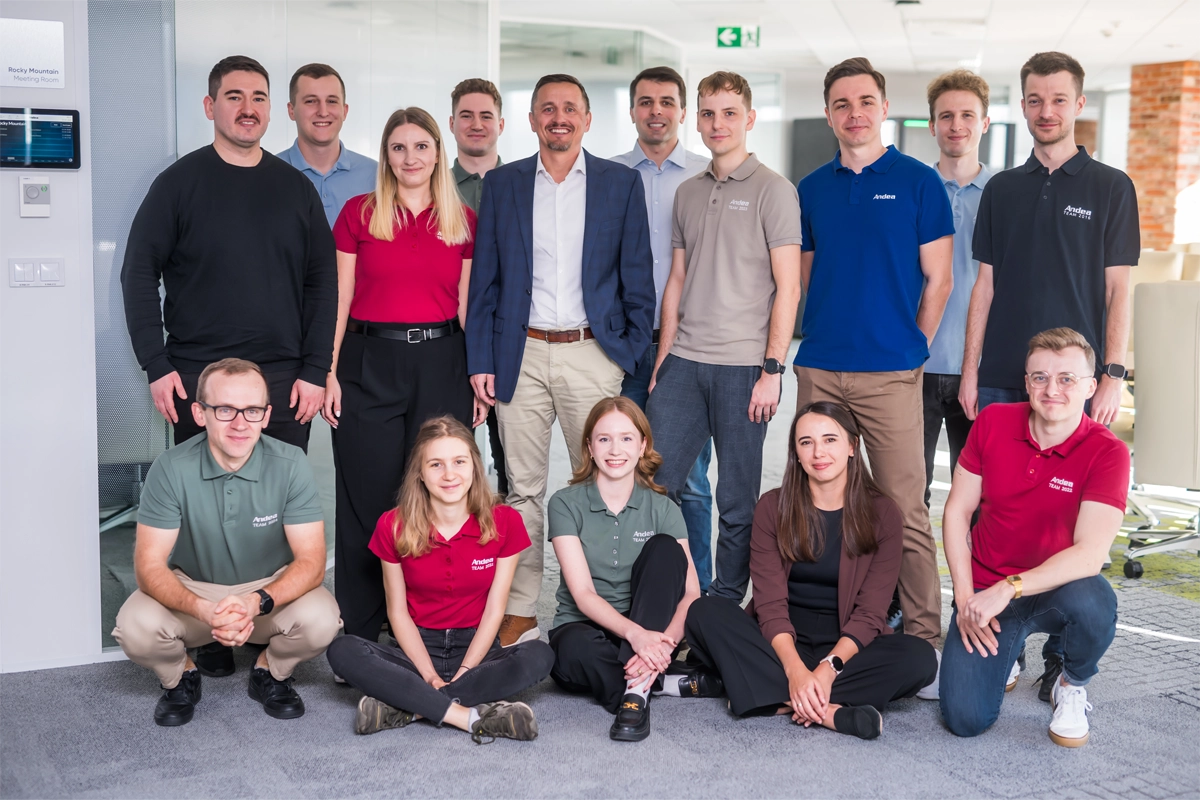

Marcin Doliński
Director, Solution Maintenance
Andea's application maintenance and support services keep your manufacturing applications, MES (DELMIA Apriso) and APS (DELMIA Ortems), secure, current, and running 24/7, so the line never stops. Unlike generic IT outsourcers, Andea maintains the systems it implements, combining application, database, and integration support in one team. The result: lower downtime, faster fixes, and predictable SLA-backed performance, with a 100% SLA achievement rate across all active contracts in 2026 and a 9.6/10 average client satisfaction score.


Andea solves six MES and APS problems that typically push manufacturers to change their application maintenance partner: missing platform expertise, slow resolutions, risky upgrades, degrading performance, integration gaps, and opaque support ROI. Is your application maintenance becoming a production risk?
Your staff understands the business perfectly. However, fixing DELMIA Apriso and Ortems requires specialized expertise you might not have in-house.
When the line is down, every minute costs. Generic support queues and unclear escalations turn simple fixes into long and costly waits.
Fear of breaking live production delays necessary updates, making future changes harder and widening your capability gap.
Slow screens and lagging background jobs often go ignored until they directly damage your output and on-time delivery.
MES sits between your ERP and the shop floor. When connections fail, you get finger-pointing instead of fast solutions.
Vague SLAs and unclear hour tracking make it impossible to tell if your contract is protecting your production or just billing hours.
Your MES and APS platforms stay fully maintained and production-ready, along with their underlying databases and every integration connecting them to your ERP and shop floor equipment. Because Andea works exclusively on DELMIA Apriso and Ortems, our application support services cover your entire production environment.
Keep your core Manufacturing Execution System production-ready across all shifts. Get continuous maintenance for your Apriso environment to prevent downtime, resolve incidents, and proactively optimize application performance.
Core Application & Database Support: Full maintenance of Apriso application servers, custom Process Builder workflows, and underlying databases.
Proactive Monitoring: Real-time tracking of server health, database query locks, background jobs, and license pool availability to eliminate shift-start lockouts.
Performance Tuning & Extensions: Optimizing slow database queries, refining reporting, building new workflows, and executing safe environment upgrades.
Ensure your Advanced Planning and Scheduling system delivers accurate, execution-ready schedules that match real shop floor conditions.
Scheduling Model Tuning: Calibrating and optimizing planning criteria (on-time delivery, machine utilization, sequence-dependent changeovers) to keep schedules realistic and aligned with actual production goals.
ERP Data Feed Management: Diagnosing and resolving errors in ERP data feeds (missing fields, malformed values) that cause planning failures or unusable plans.
Data Modeling & Expansion: Configuring certified SAP Adapters, building custom integrations for other ERPs (Microsoft Dynamics, custom systems, Excel), and modeling new planning data directly in Ortems.
DELMIA Apriso sits between your IT layer and your plant floor. We debug and maintain the entire integration stack so data flows seamlessly from machine controllers up to corporate systems.
ERP Interfaces: Maintaining real-time data exchange for production orders, inventory transactions, and quality notifications between Apriso and SAP, Oracle, or Microsoft Dynamics.
Shop Floor Integration (OT): Managing SCADA and PLC data feeds to ensure reliable transfer of machine status, production counts, and quality readings.
Interface Queue Management: Proactively monitoring, identifying, and clearing stuck or failed transactions before they impact shop floor operations.
Adaptive Integration Maintenance: Updating integration logic and interfaces whenever connected ERP or SCADA systems undergo version upgrades.
When a line stops or a transaction fails, we debug across the application, database, and integration layers simultaneously. One team owns the issue end-to-end – and if the root cause turns out to be a platform defect, we escalate it to the software vendor and handle that communication for you.
Application maintenance and support (AMS) keeps your software running smoothly after go-live. While standard business apps just need routine bug fixes, an MES running three shifts demands much more. The system must stay online, and your support team must understand the immediate shop floor impact if it fails.
We maintain DELMIA Apriso and DELMIA Ortems in production environments where downtime is not just a minor delay, but translates directly to stopped lines, missed shipments, and scrap. We understand exactly what is at stake.
These terms are often used interchangeably, even though they describe different scopes of service. Know the difference to set proper expectations.
Application maintenance | Application support | |
|---|---|---|
Focus | The software – code, configuration, integrations, performance | The people using it – incidents, questions, access issues |
Trigger | Scheduled or proactive – upgrades, environment changes, optimization | Reactive – user-reported issues, incidents, service requests |
Who handles it | L2 and L3 engineers with deep application and database knowledge | L1 and L2 with process and configuration knowledge |
Output | Patched, upgraded, optimized application | Resolved ticket, workaround, escalation |
Andea's AMS contract covers both day-to-day support and ongoing application maintenance services, so you don't need separate vendors or separate escalation paths.
AMS contracts are structured around support tiers. Each tier handles a different class of issue: L1 (your internal helpdesk) provides basic user help and incident logging; L2 (Andea) resolves functional, configuration, and integration issues; L3 (Andea) handles code-level bugs, performance root-cause analysis, and upgrades; and L4 (the software vendor) fixes confirmed platform defects.
Tier | Who handles it | What it covers |
|---|---|---|
L1 | Client's internal IT helpdesk or shared service center | User access issues, password resets, basic navigation, incident logging. L1 does not touch application configuration or code. |
L2 | Andea – application specialists with configuration and integration knowledge | Functional issues, configuration changes, workflow problems, integration errors between Apriso and ERP or SCADA. This is where most incidents land. |
L3 | Andea – senior engineers with application code and architecture knowledge | Complex bugs requiring code changes, performance root-cause analysis, database optimization, upgrade execution, custom Process Builder development. |
L4 | Software vendor – platform owner responsible for product fixes and releases | Confirmed platform defects requiring a product fix, hotfix releases, version roadmap. We escalate to L4 when needed and manage communication with the vendor on your behalf. |
Andea owns the application layer end-to-end: configuration, code, integrations, database optimization. First-line triage stays with your helpdesk. Confirmed platform defects go to the software vendor, and we run that escalation for you.
Every Andea maintenance engagement covers four categories of work: corrective (fixing bugs and failures), adaptive (keeping the application compatible with environment changes), perfective (improving the system without fixing a specific bug), and preventive (finding problems before your users do). The mix shifts depending on the client's needs and the environment's maturity, but all four are necessary.
Type | What triggers it | What we do |
|---|---|---|
Corrective | A bug, error, or failure – reported by a user or caught by monitoring | Identify the root cause and fix it. For an MES issue affecting the production line, corrective maintenance must happen fast – sometimes within minutes. |
Adaptive | A change in the environment – ERP upgrade, new OS, regulatory change, new shop floor equipment | Update the application to stay compatible by adjusting interfaces and configuration and building new Process Builder workflows. MES sits between ERP and shop floor hardware, so adaptive maintenance is frequent in active production. |
Perfective | No failure, but a recognized improvement – performance, code quality, new functionality | Improve the system without fixing a specific bug in Apriso, this includes optimizing databases queries, extending reporting, or improving user interface. |
Preventive | Scheduled review or monitoring alert – before anything breaks | Monitor performance counters, review logs, audit dependencies, and apply patches. The goal is to find problems before your users do. |
Andea's 35+ application maintenance specialists work exclusively on DELMIA Apriso and Ortems, and our longest active client relationship has lasted 12 years. In 2026, Andea met 100% of its SLA targets across all active contracts, with a +84 NPS and a 9.6/10 average client satisfaction score. We believe the best maintenance is the kind your production never notices. That is why we take a proactive approach: continuously monitoring, optimizing, and improving your MES before issues touch your operations. Whether you are upgrading your current support or switching providers, your business continuity stays protected.

We take over in 2 to 6 weeks – while your current provider stays active, so support never stops.
The fastest way to resolve a DELMIA Apriso issue is to work with specialists who know how it was built. When Andea maintains a system it deployed, there is zero knowledge gap. When we take over an environment built by another partner – which accounts for more than half of our active AMS projects – we conduct a structured 2-to-6-week knowledge transfer. We review documentation, map production processes, walk the shop floor, and run a full kick-off before touching live code.
Because our consultants work exclusively on DELMIA Apriso and Ortems, your assigned team often ends up knowing your implementation better than your internal IT department.
Business Impact & Proven Performance
In manufacturing, unplanned downtime averages ~$9,000 per minute across industries (Ponemon Institute), with higher figures in automotive and electronics plants. An MES outage directly degrades OEE, throughput, and on-time delivery. We protect your bottom line with measurable performance:
100% SLA Achievement Rate across all active maintenance contracts in 2026.
+84 NPS & 9.6 / 10 average client satisfaction rating.
12 years: the longest active client relationship.
Direct Access: Emergency calls route straight to your dedicated focus team – no generic helpdesk or gatekeepers.
Waiting for support tickets means waiting for production to stop. Andea tracks your DELMIA Apriso environment in real time, alerting our on-shift team before threshold breaches impact the shop floor:
Application & Database: Tracking server response times, error rates, query performance, and lock contention.
Interface Queues: Monitoring ERP data feeds for production orders, inventory, and quality notifications.
System Jobs & Licensing: Verifying scheduled job execution and license pool availability to prevent shift-start user lockouts.
When an alert does turn into an incident, your dedicated focus team takes it over directly, logs it with full root cause analysis (RCA), and resolves it within the SLA defined for its priority level.
Every Andea contract defines response and resolution times per priority level, with standard targets ranging from a 30-minute response and 8-support-hour resolution for P1 critical incidents to a 16-hour response for P4 minor issues. P2 and P3 incidents receive a 1-hour and an 8-hour response, with resolution targets of 16 and 40 support hours respectively. We report on SLA performance, incident volume, resolution times, and open change requests on a cadence agreed with the client. When incidents occur, clients contact their dedicated focus team via a direct line. Every issue is logged in YouTrack (or your internal ticketing tool) with full root cause analysis (RCA).
Priority | Definition | Response time | Resolution target |
|---|---|---|---|
P1 – Critical | Core functionality or service down for multiple users | 30 minutes | 8 support hours |
P2 – Critical | Core functionality down for one user, or service degraded for multiple users | 1 hour | 16 support hours |
P3 – Major | Core functionality or service degraded for one user | 8 hours | 40 support hours |
P4 – Minor | No degradation of service | 16 hours | 120 support hours |
MES environments are prime targets for ransomware and OT cyberattacks – with Claroty reporting 75% of OT organizations hit annually. Unpatched MES applications and legacy OS versions are primary vectors. Andea integrates security directly into its preventive maintenance scope:
Regular security patching for DELMIA Apriso and core application components.
Database security audits (user permissions, access logging, data encryption).
Integration authentication reviews across Apriso, ERP, and SCADA endpoints.
Continuous vulnerability monitoring across all supported Apriso versions.
For life sciences, medical devices, and food & beverage manufacturers, changes to validated Apriso systems require rigorous governance. We provide impact assessments and documentation aligned with FDA 21 CFR Part 11 and GxP frameworks. During post-upgrade hyper-care periods, we apply tightened monitoring cadences and accelerated escalation paths until stability is fully verified.
Andea offers three tailored structures to match your operational predictability and support volume: pre-paid hours, managed services with a dedicated FTE, and pay as you go. Pricing depends on system complexity and is scoped individually after a system review.
Model | How it works | Best for |
|---|---|---|
Pre-paid hours | You purchase a block of hours for the year. Hours can be consumed at your own pace. Additional hours can be added mid-contract. | Predictable annual cost, flexible consumption. Most common starting point. |
Managed services (FTE) | You engage a dedicated full-time equivalent. A specialist is assigned to your account and delivers a defined scope. Teams often stay consistent across projects for years. | High, consistent support volume. Clients who prefer a named resource. |
Every engagement features clearly defined application maintenance and support roles and responsibilities, ensuring your environment is backed by a structured, specialized team:
Single Point of Contact (SPOC): An account owner who manages the overall relationship, coordinates all incoming requests, and handles escalations.
Dedicated Focus Team (2–4 Specialists): Engineers who complete knowledge transfer and remain permanently assigned to maintain your specific environment.
L3 Senior Engineer: A senior specialist who handles code-level bug fixes, custom Process Builder development, and complex upgrade executions.
Database Administrator (DBA): A database expert who manages MS SQL administration, performance tuning, and Data Warehouse support.
QA / Test Engineer: A quality specialist who executes regression testing for major change requests and platform upgrades.
When you work with Andea, your application is in the hands of experts who combine decades of direct
DELMIA Apriso and Ortems experience with deep expertise in manufacturing software architecture.
Director, Solution Maintenance
Director, Solution Maintenance
Director, Solution Maintenance
Senior APS Solution Architect
Our clients trust us to keep their manufacturing execution systems running smoothly. Let their feedback speak for the quality and impact of our services.
We are highly content with all the work and the designed solutions. Andea’s knowledge of the Apriso platform, combined with reliability and a professional approach left a lasting impression on everyone involved here at Magna.
Andea turned out to be a great partner to collaborate with. Implementing their recommendations has significantly improved the performance of our solution. Simultaneously, they enabled the addition of new source systems and further development. Throughout the process, maintenance, implementation of corrections, and change requests have always been carried out successfully. We consider Andea to be both a flexible and capable partner.
Look for platform depth, clear support tiers, and proven SLA metrics. Generalist IT firms can handle basic L1 tickets, but Apriso and Ortems require L2 and L3 specialists who understand the system's architecture. Always ask for actual SLA achievement rates and client retention figures, not just contractual targets. Working exclusively on these platforms, Andea's specialists diagnose production issues in minutes rather than learning on your time.
Cost depends on system complexity, support volume, and your engagement model: pre-paid hours (the most common starting point), managed services with a dedicated FTE, or pay as you go. Most clients start with pre-paid hours and adjust the block size once usage stabilizes. Andea scopes every engagement individually after a system review to deliver an exact figure rather than a generic range.
Through a structured 2-to-6-week knowledge transfer completed before Andea takes ownership. We review documentation, map processes, and walk the shop floor while your current provider remains active. Because more than half of our active AMS projects were built by other partners, this handoff is routine for us. We only assume full L2/L3 support when the team is completely prepared.
Yes. Most production environments include custom Process Builder workflows, integrations, reports, and database extensions developed over many years. Andea's engineers investigate issues across application code, databases, and integrations, so customizations become part of the maintenance scope – not a reason to decline support.
Yes. Andea's role is typically to complement – not replace – your internal IT team. Your team can continue handling infrastructure, user administration, and first-line support, while we take responsibility for application maintenance, complex incidents, integrations, upgrades, and performance optimization.
Application maintenance and support (AMS) is the ongoing service keeping software operational after deployment. It covers four activity types: corrective (fixing bugs), adaptive (environment updates), perfective (performance improvement), and preventive (proactive monitoring and patching). Support is the human layer of user assistance, handling incidents, user requests, and escalations while accounting for manufacturing schedules and shop floor downtime.
In software, AMS is the post-deployment phase of the application lifecycle beginning after go-live. It is distinct from implementation and modernization. A managed AMS contract defines service scope, support tiers, SLA commitments, and engagement models.
A Manufacturing Execution System (MES) like DELMIA Apriso tracks production orders, work-in-progress, and quality data while integrating with ERP and shop floor equipment. Maintenance ensures it remains upgraded, integrated, and operational across production shifts. An Advanced Planning and Scheduling (APS) system like DELMIA Ortems is another example, requiring maintenance for scheduling models, ERP data feeds, and solver performance.
AMS stands for Application Management Services or Application Maintenance and Support. In IT outsourcing, AMS covers L1–L3 support and software maintenance: bug fixing, version upgrades, security patching, and performance optimization. In manufacturing, specialized AMS requires deep knowledge of production processes, OT/IT integration (ERP, SCADA, PLCs), and specific software platforms.
Application maintenance keeps an existing system operational, stable, and environment-aligned. Application modernization replaces or re-architects the system via cloud migration or new platforms. For DELMIA Apriso and Ortems, maintenance is the ongoing post-go-live discipline. Manufacturers prioritize maintenance over modernization to avoid high operational disruption during live production.
An application maintenance specialist keeps software applications operational post-deployment. Daily tasks include incident resolution, root cause analysis (RCA), patching, change requests, performance monitoring, and version upgrades. In manufacturing software, this requires knowledge of production workflows, ERP, and shop floor integrations. At Andea, specialists work exclusively on DELMIA Apriso or DELMIA Ortems.
Andea is a licensed partner of Dassault Systèmes. Our application maintenance team works exclusively with DELMIA Apriso and Ortems, and with the databases that support them.
If you are evaluating AMS providers or looking to move from your current provider, let's talk.